X-Ray Diffraction · XRD Analysis

Crystal Structure Analysis Technology

X-Ray
Diffractometer

Phase Identification Rietveld Analysis Residual Stress Retained Austenite Non-Destructive

X-Ray Diffraction (XRD) is one of the most powerful analytical methods for non-destructively examining the crystal structure, chemical composition and physical properties of materials. It serves a wide range from quality control to advanced R&D.
6
Core application areas
4
Dedicated XRD systems
0%
Sample destruction
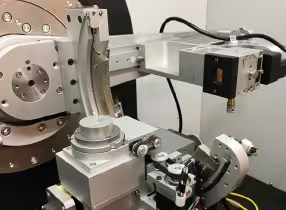
XRD_GNR_Goniomter
🔬
Phase ID
Qualitative and quantitative crystal phase analysis, Rietveld method
⚙️
Residual Stress
Bragg angle shift maps tensile/compressive stress distribution
🏭
Ret. Austenite
Steel heat treatment quality control, ASTM E975-03 compliant
Non-Destructive
Sample integrity preserved; in-situ measurement on industrial parts
Bragg's Law
nλ = 2d·sin θ
When X-rays are reflected from crystal planes, constructive interference occurs only at specific angles. These angles form the diffraction pattern — the unique "fingerprint" of the material.
nDiffraction order (positive integer)
λX-ray wavelength (typically Cu Kα, 1.5406 Å)
dInter-planar spacing (d-spacing)
θBragg angle — between X-ray beam and plane

Fingerprint Analysis
of Crystal Structure

X-rays diffract from atomic planes within the material. Each crystalline phase produces peaks at its characteristic Bragg angles. These patterns are matched against reference databases to identify the material's composition and structure.

📡
X-Ray Generation and Focusing
An X-ray tube (typically Cu, Mo or Co anode) generates monochromatic radiation. The optical system focuses the beam onto the sample surface.
🔄
Theta/Theta Geometry
Tube and detector move simultaneously while the sample remains stationary. This provides ideal conditions for powder and bulk samples with a wide 2θ scan range.
📊
Database Matching and Rietveld
Software compares the diffraction pattern against millions of standards in the ICDD PDF database. Rietveld analysis calculates the weight percentage of each phase.

XRD Analysis
Application Areas

Advanced detector technologies and powerful software platforms allow XRD systems to serve both industrial quality control and advanced R&D requirements on a single platform.

🔍
Phase Identification
Qualitative detection of crystalline phases (minerals, compounds, intermetallics) in unknown samples. Diffraction pattern is matched to the ICDD database for "fingerprint" identification.
Qualitative Analysis
⚖️
Rietveld Analysis
Calculates the weight percentage of each phase in mixtures with high accuracy. Based on full-pattern mathematical modelling — the standard method for quantitative phase analysis.
Quantitative Analysis
📏
Thin Film Analysis
GIXRD for structural analysis of surface layers only; XRR for nm-level measurement of layer thickness, density and surface roughness. Critical for coating and semiconductor applications.
GIXRD / XRR
⚛️
Nano-Particle Analysis
Peak broadening analysed via the Scherrer equation to calculate crystallite size and micro-strains. Non-destructively determines average grain size of nano-materials.
Scherrer Equation
⚙️
Residual Stress Analysis
Non-destructive detection of tensile or compressive stresses built up during casting, welding, machining and heat treatment. Stress is calculated from Bragg angle shift in the crystal lattice.
sin²ψ Method
🔩
Retained Austenite
Measurement of austenite that failed to transform to martensite during quenching, to industrial standards. Directly affects hardness, dimensional stability and wear resistance of steel parts.
ASTM E975 / SAE SP-453

GNR Series
XRD Analysis Systems

Italian GNR Analytical Instruments XRD systems range from powder diffractometers to dedicated residual stress and retained austenite analysers — a specialised solution for every need.

Powder XRD · Multipurpose
GNR APD 2000 PRO
Theta/Theta Powder XRD Diffractometer
High-performance Theta/Theta system for qualitative and quantitative XRD analysis of polycrystalline materials. Phase identification, Rietveld analysis, thin film (GIXRD/XRR), nano-particle crystallite size and residual stress — all on one platform.
Theta/Theta Geometry GIXRD / XRR Rietveld Scintillation + PSD
Product Page →
Modular · Research
GNR Explorer
Multi-Purpose XRD Diffractometer
Theta/Theta geometry with plug-and-play modular optics architecture. High-resolution system for powder diffraction, thin film analysis, residual stress and Rietveld. Expandable with different detector and optic combinations.
Modular Optics High Resolution Thin Film Residual Stress
Product Page →
Industrial · Field
GNR Residual Stress Analysers
StressX & SpiderX Edge
Dedicated industrial XRD systems for non-destructive residual stress measurement after welding, casting, machining and heat treatment. sin²ψ method supported; UNI EN 15305 and ASTM E915 compliant.
sin²ψ Method ASTM E915 UNI EN 15305 Field Ready
Product Page →
Specialist · Ret. Austenite
GNR AreX / AreX D
Retained Austenite Analyser
Fast determination of retained austenite in quenched and tempered steel parts, compliant with ASTM E 975-03. 3-minute measurement time, 1% precision, automatic analysis software. Critical quality control for automotive and bearing steel industries.
ASTM E975-03 3-Min Measurement 1% Precision Auto Software
Product Page →

About XRD Analysis

XRD provides: phase identification (which crystal phases are present?), quantitative phase analysis (how much of each?), crystal lattice parameters, crystallite size, micro-strains, residual stress, retained austenite content, and thin film properties. All these analyses can be performed non-destructively on the same sample.

XRF (X-Ray Fluorescence) determines elemental composition — it answers "which elements are present and in what amounts?". XRD analyses crystal structure — it answers "in which crystalline phases do these elements reside?". For example, with an iron-containing sample, XRF gives the iron content while XRD reveals whether the iron exists as ferrite, austenite or cementite.

XRD is widely used in: steel and metallurgy (residual stress, retained austenite), mining and ceramics (mineral phase analysis), pharmaceuticals (polymorph analysis), cement and construction materials (clinker phase ratios), semiconductors and electronics (thin film analysis), automotive (component quality control), and academic research (materials development).

Manufacturing processes (welding, grinding, casting, heat treatment) create permanent internal stresses in materials. Tensile stresses accelerate fatigue cracking and shorten service life; compressive stresses improve strength. XRD non-destructively maps these stresses by measuring Bragg angle shift, enabling process parameter optimisation.

Austenite that fails to transform to martensite during quenching remains as "retained austenite". This phase reduces part hardness, impairs dimensional stability and decreases wear resistance. In high-performance applications such as automotive gears and bearings, measuring retained austenite to 1% precision per ASTM E975-03 is mandatory.

Decision points: For retained austenite only, AreX / AreX D is sufficient — speed and operator simplicity are the priority. For residual stress and field measurement, StressX or SpiderX Edge is preferred. For a multipurpose R&D lab, the Explorer's modular design is ideal. For routine phase analysis and full powder XRD including thin film, the APD 2000 PRO is the choice. Contact us for a demo and technical consultation.

Request a Demo
with Your Sample

Contact our expert team for XRD analysis systems, application support or sample measurement. Over 25 years of experience at your side.
📞
+90 (216) 577 52 96Call us directly
info@ankaanalitik.com.trSend an email
💬
WhatsApp Line+90 549 252 76 46
📍
Kadıköy, Istanbul19 Mayıs Mah. Sumer Sok. Sumko Sitesi A7 Blok No:3CL
Demo / Information Request