Particle Size Measurement Technology
Laser diffraction measures the angular intensity distribution of light scattered by particles and converts it into a particle size distribution. The full range from 0.02 µm to 3,500 µm is covered in a single pass. Measurement time is under 60 seconds, with results verifiable against ISO 13320.
Optical System
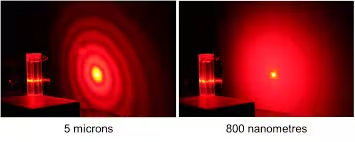
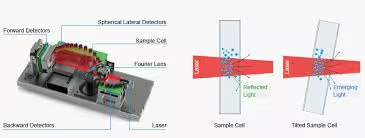
Most standard laser diffraction systems operate between 0° and 90°. Small particles scatter light at angles beyond this range, which introduces measurement error. The DLOI (Dual Lens Optical Instrument) system covers the full angular range from 0.016° to 165° in a single measurement — without lens changes.
Calculation Models
Two mathematical models describe how light interacts with particles in laser diffraction. Selecting the correct model is critical for reliable results.
Application Areas
Laser Diffraction Instruments
All Bettersize instruments use the DLOI wide-angle optical system. Model selection is based on measurement range, dispersion requirements, and application.
Frequently Asked Questions
A laser beam interacts with particles in the sample and scatters. Small particles scatter light at wide angles; large particles scatter at narrow angles. Detectors measure this angular intensity distribution. The software then converts the scatter pattern into a particle size distribution using either Mie theory or the Fraunhofer approximation. A typical measurement completes in under 60 seconds.
Modern laser diffraction instruments measure from 0.02 µm to 3,500 µm. The lower limit depends on the optical system — the DLOI wide-angle optic reaches 0.02 µm. The upper limit is determined by the dispersion unit capacity. A single instrument covers both nano-scale particles and coarse powders.
The Fraunhofer approximation is sufficient for opaque particles above 1 µm and requires no refractive index input. Mie theory is preferred for particles below 1 µm or for transparent materials; it requires the material's real and imaginary refractive indices for accurate calculation. Most modern software supports both models.
Wet dispersion is suited for powders sensitive to solvation, pharmaceutical APIs, and fine particles — the liquid medium separates agglomerates and reveals true primary particle size. Dry dispersion is preferred for solvent-sensitive materials, high-throughput routine analysis, and samples that are stable in air. Some instruments support both modes on the same platform.
ISO 13320 is the international method standard for particle size analysis by laser diffraction. Compliance means the instrument meets defined criteria for measurement principle, validation procedures, and reporting requirements. This standard is widely referenced in pharmaceutical, food, and chemical industry specifications.
Key decision points: if particle shape also needs to be measured, the Bettersizer 2600 Plus or S3 Plus includes the PIC-1 imaging module. If size distribution alone is sufficient, the 2600E or ST is more cost-effective. If the 0.1–1,000 µm range covers your needs, the ST is adequate; for wider ranges, the 2600 series is the better fit. Contact us for a demo with your own sample material.
Demo & Consulting
Contact our team for laser particle size analysis instruments, application support, or sample measurement. Bettersize Authorized Distributor in Türkiye, with over 25 years of experience.