GNR · Authorized Distributor in Türkiye

Powder X-Ray Diffraction System (XRD)

GNR
APD 2000 PRO

Theta/Theta Geometry High-Precision Goniometer Multi-Detector Architecture IEC Safety Certified Rietveld Software

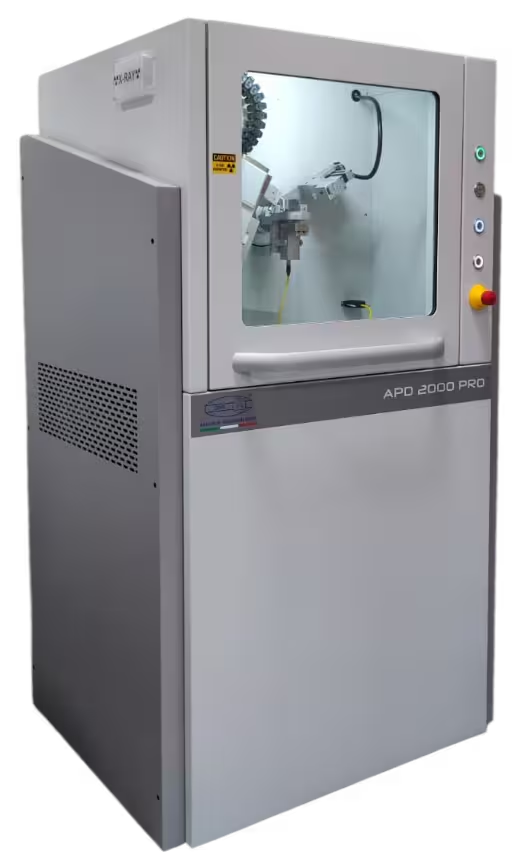
The GNR APD 2000 PRO is a Theta/Theta powder X-ray diffractometer designed for qualitative and quantitative XRD analysis of polycrystalline materials. Built on over 40 years of manufacturing experience, it delivers angular accuracy better than ±0.02° across the full 2-Theta range with a broad choice of detector technologies.
±0.02°
Angular accuracy
165°
2-Theta scan range
3 kW
X-ray generator
40+ yrs
GNR manufacturing experience
GNR APD 2000 PRO XRD System
🔷
-5° to +160°
2-Theta scanning range
🎯
±0.02°
Angular accuracy (full range)
🔬
<0.04° 2Θ
Peak resolution
3 kW
X-ray generator power
🔷
Theta/Theta
Goniometer geometry
📡
SDD · HPC · 2D
Supported detector types
<1 mSv/yr
Radiation safety limit
🧪
6 Anodes
Cu, Co, Fe, Cr, Mo, W options
GNR APD 2000 PRO — Theta/Theta Goniometer

Sample Stays Still,
Accuracy Doesn't Slip

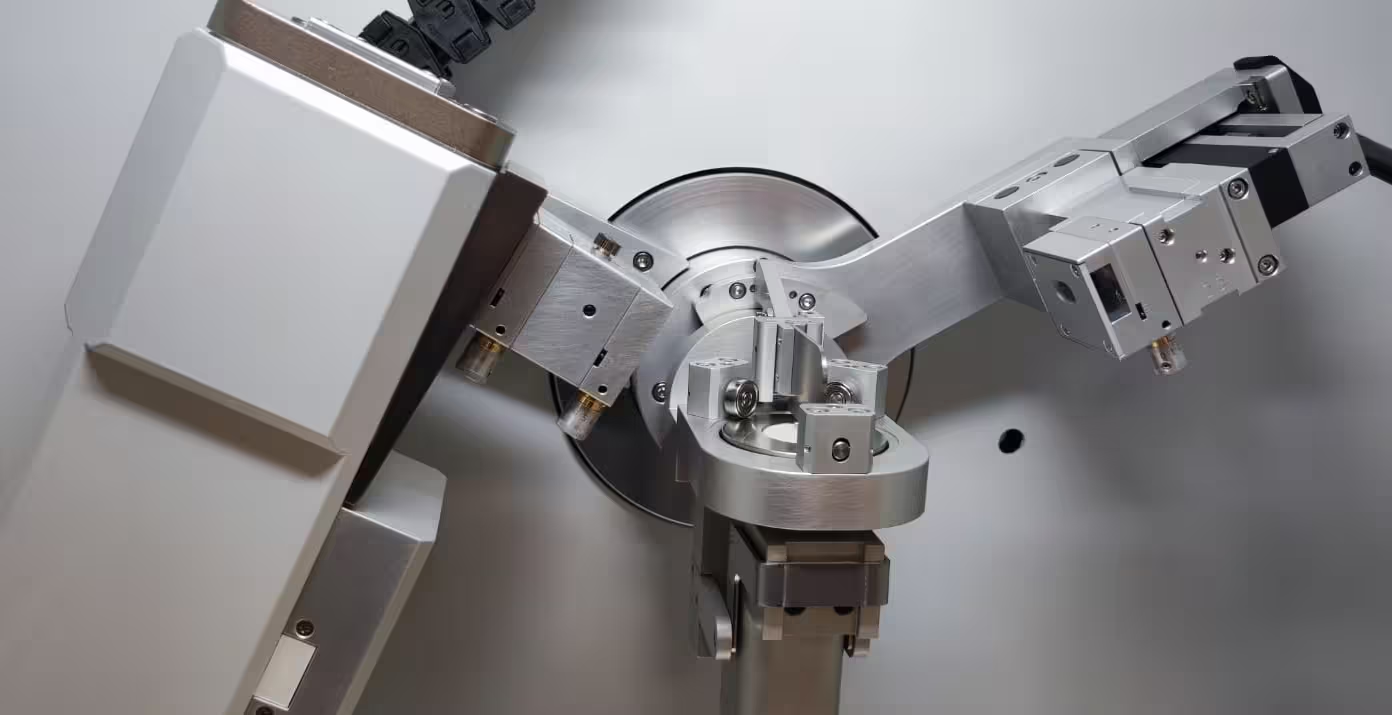
In Theta/Theta geometry, the tube and detector arms rotate symmetrically while the sample surface stays horizontal throughout the measurement. This makes the system well-suited for loose powders, liquids, coatings, and fragile or heavy samples.
🎯
Stepper Motors with Optical Encoders
Integrated optical encoders on each axis deliver angular accuracy better than ±0.02° and peak resolution below 0.04° 2-Theta across the entire scanning range.
🔷
Fixed Sample Position
The sample remains stationary and horizontal during the full scan. Heavy or spillable specimens require no special mounting fixtures.
Wide-Angle Scanning Capability
The -5° to +160° 2-Theta range covers low-angle clay mineralogy through high-angle crystal structure analysis on a single platform.
GNR APD 2000 PRO — X-Ray Tube and Detector Options

Flexible Source,
Fast Detection

The APD 2000 PRO supports multiple anode options matched to different sample matrices, alongside three modern detector technologies that cut measurement times from hours to minutes.

🧪
Multiple Anode Options
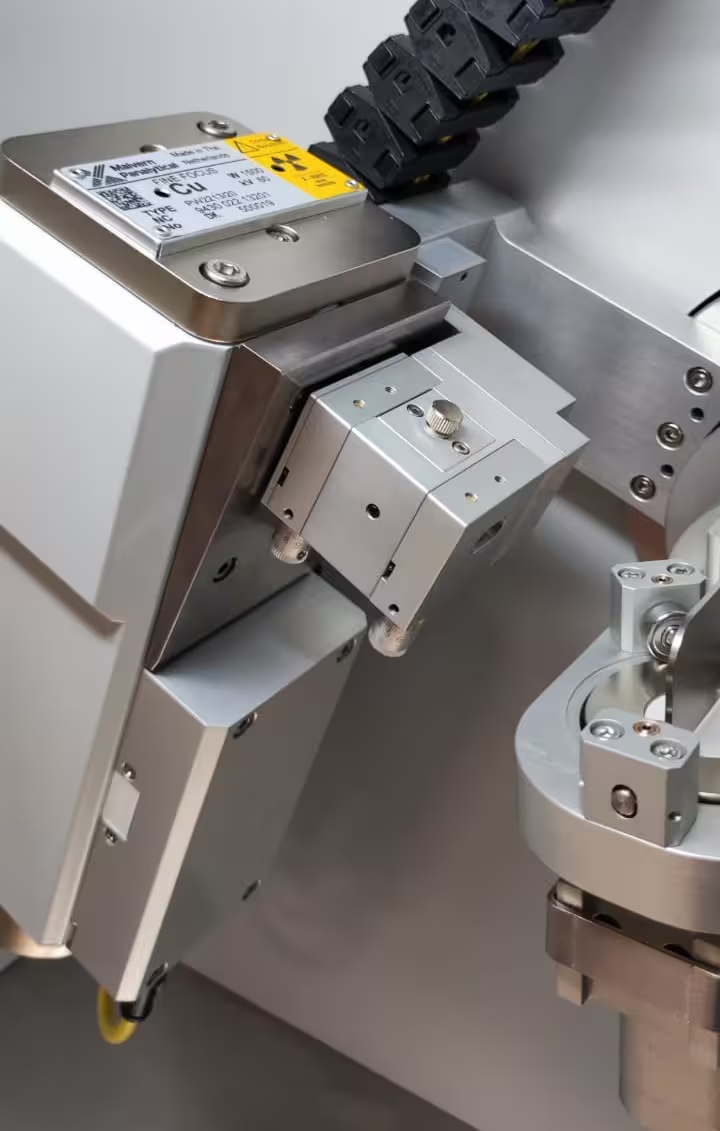
Cu is the standard anode; Co, Fe, Cr, Mo, W, and Ag are available as alternatives. Co or Fe anodes reduce fluorescence background in iron-bearing sample matrices.
📡
Three Detector Technologies
Silicon Drift Detector (SDD) for high-resolution energy-dispersive detection; Dectris 1D HPC microstrip for fast, low-noise 1D acquisition; Advacam 2D hybrid pixel detector for full 2D diffraction pattern imaging.
Fail-Safe Safety Interlock
Fully compliant with IEC X-ray and electrical safety standards. An automatic interlock immediately cuts X-ray generation if the enclosure door is forced open. Radiation dose remains well below the 1 mSv/year threshold.

From Academia to Industry —
A Wide Range of Analytical Uses

Phase Analysis
Qualitative and quantitative crystalline phase identification in polycrystalline materials. Polymorph screening and mixed-phase ratio determination.
💊
Pharmaceuticals
Degree of crystallinity calculation in active pharmaceutical ingredients. Monitoring of unstable amorphous phases and polymorph compatibility testing.
🔬
Nanomaterials
Crystallite size estimation via Scherrer method and Rietveld refinement. Lattice strain and structural defect analysis.
🌱
Environmental Health
Quantification and monitoring of hazardous crystalline silica dust (quartz, cristobalite) collected on air filters.
🏺
Clay Mineralogy
Identification of clay basal reflections using oriented aggregates at low diffraction angles (2-Theta <5°).
Geology & Mining
Mineral phase analysis in rock and ore samples. Phase purity control for beneficiation processes.
🏭
Materials Science
Structural characterisation of metallic and ceramic materials. Phase transformation analysis after heat treatment.
🔋
Battery & Ceramics
Phase purity and crystal structure verification of cathode and anode materials. Post-sintering ceramic phase analysis.

Common Questions

The instrument scans from -5° to +160° 2-Theta. The lower limit covers low-angle applications such as clay mineralogy, while the upper limit is sufficient for high-symmetry crystal structure studies. The practical range may vary depending on the accessory or sample geometry in use.

In a Theta/Theta configuration, both the X-ray tube and the detector rotate by equal angles while the sample stays fixed and horizontal. This is practical for loose powders, liquids, coatings, and heavy or fragile specimens. Sample preparation is generally simpler than in a standard Bragg-Brentano geometry where the sample stage moves.

The APD 2000 PRO supports three detector technologies: a Silicon Drift Detector (SDD) for high-resolution energy-dispersive detection; a Dectris 1D HPC microstrip detector for fast, low-noise 1D acquisition; and an Advacam 2D hybrid pixel detector for full 2D diffraction pattern imaging. The choice depends on the required measurement speed and spatial resolution.

The standard anode is Cu (copper). Co, Fe, Cr, Mo, W, and Ag are available as alternatives. For iron-bearing sample matrices, Co or Fe anodes significantly reduce fluorescence background. Anode selection should be based on sample composition and the analysis objective.

The APD 2000 PRO comes with a modular software suite that includes Match! and FullProf. Match! handles phase identification and qualitative analysis; FullProf is an industry-standard open-source program for Rietveld refinement and quantitative phase analysis.

The APD 2000 PRO is fully compliant with IEC X-ray and electrical safety standards. Radiation dose around the instrument remains well below the 1 mSv/year safety threshold. An automatic fail-safe interlock cuts X-ray generation immediately if the protective enclosure door is forced open.

Request a Quote for
APD 2000 PRO

Contact our technical team for pricing, a demo, or application support. Over 25 years of analytical instrument expertise at your service.
📞
+90 (216) 577 52 96Call us
info@ankaanalitik.com.trSend an e-mail
💬
WhatsApp+90 549 252 76 46
📍
Kadıköy, Istanbul19 Mayıs Mah. Sumer Sok. Sumko Sitesi A7 Blok No:3CL
Quote / Information Request