Sieve Analysis · Particle Size
Sieve analysis is the most established and reliable method for determining particle size distribution of powders and granules. From mining to pharmaceuticals, construction to chemicals — an indispensable tool for quality control. Endecotts covers everything from compact benchtop models to heavy-duty industrial machines.
Analysis Method
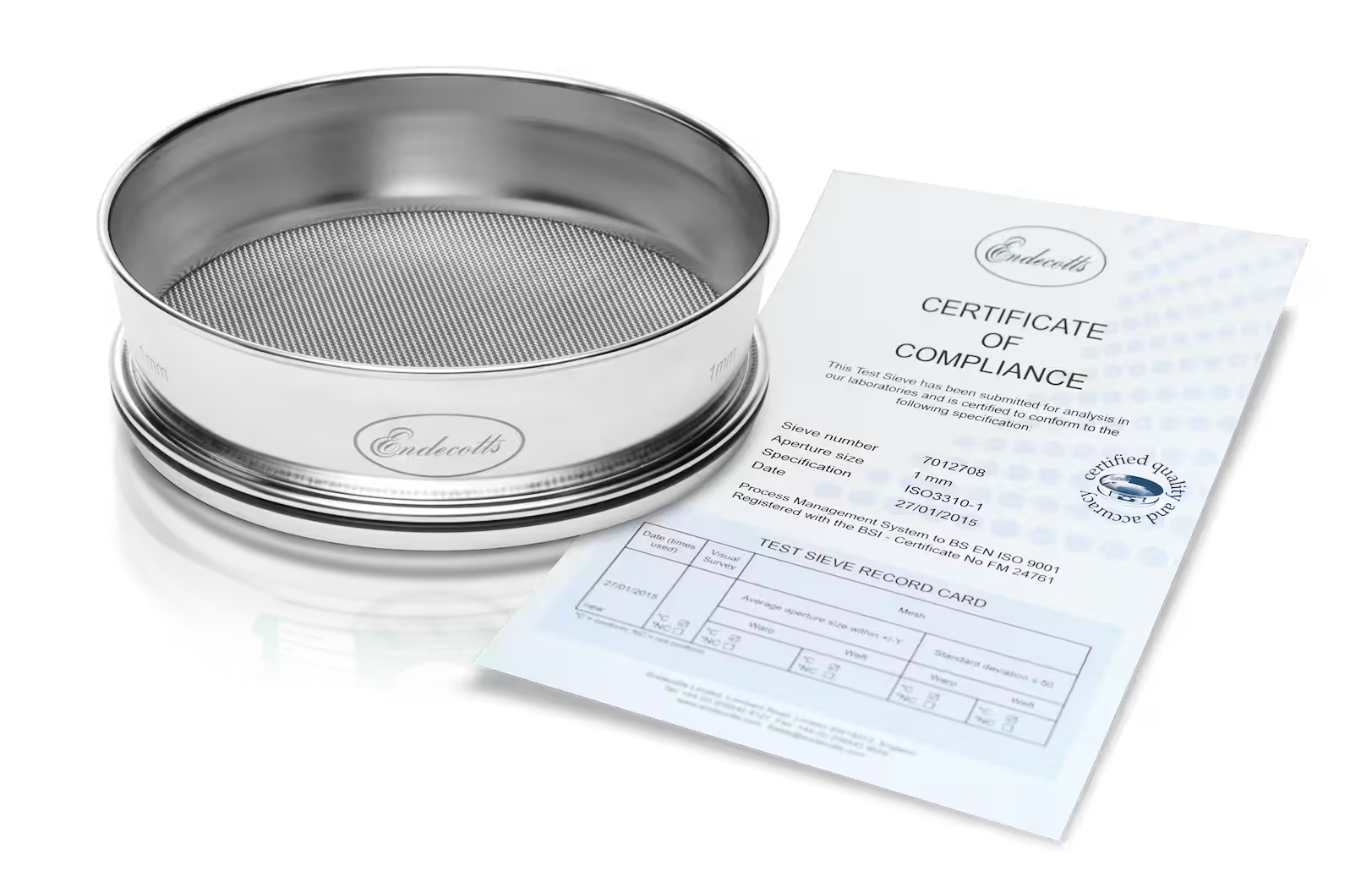
A representative sample is placed on top of a stack of sieves arranged with decreasing aperture sizes from top to bottom. The shaker runs for a set time and amplitude. Each sieve fraction is weighed and the percentage particle size distribution is calculated.

Why Sieve Analysis?
Endecotts Sieve Shakers
Six models spanning compact benchtop laboratory shakers to heavy-duty industrial capacity, standard dry sieving to air jet analysis of fine powders.
Frequently Asked Questions
A representative sample is placed on top of a nest of sieves stacked with decreasing aperture sizes from top to bottom. The shaker runs for a defined time at a set amplitude. After sieving, the mass retained on each sieve is weighed on a precision balance. The results give the percentage particle size distribution, which is plotted as a distribution curve.
Dry sieving is the standard method for free-flowing powders — no preparation required. Wet sieving is used for cohesive or electrostatic materials, dispersing the sample in a liquid before sieving. Air jet sieving (Air Sizer 200) uses a rotating air flow to keep apertures clear, giving more reliable results on very fine powders than vibratory methods.
The key questions are: How much sample per run? What sieve diameter is required (200, 300 or 450 mm)? Is wet sieving needed? Is digital result logging required for accreditation? Are the materials electrostatic or very fine? Based on your answers we can select the right model together. Contact us for a technical consultation or demo.
The "CL" in Octagon 200CL stands for Closed-Loop. This system automatically maintains the set vibration amplitude to ±0.1 mm throughout the entire analysis. On the standard Octagon 200, amplitude is set manually. The 200CL also connects to SieveWare software via RS232 for digital data capture and reporting. It is the preferred choice for accredited laboratories and quality systems requiring full traceability.
ISO 3310 defines the dimensional tolerances, wire diameter, weave geometry and verification methods for test sieves. Using sieves that comply with this standard ensures results are comparable between different laboratories and instruments. It is widely required in export, accreditation and quality certification processes across industry.
A standard analysis typically takes between 5 and 30 minutes, depending on the material, sample mass and number of sieves. Sieving time is usually established by a preliminary endpoint test: when the mass change on a sieve falls below a defined threshold, the analysis is considered complete. This avoids over-sieving and unnecessary cycle extension.
Demo & Consultation
Contact our technical team for sieve shaker selection, sieve set advice or a sample measurement. Over 25 years of experience in analytical instrumentation.