GNR · Authorized Distributor in Türkiye

XRD Residual Stress Analysis Systems

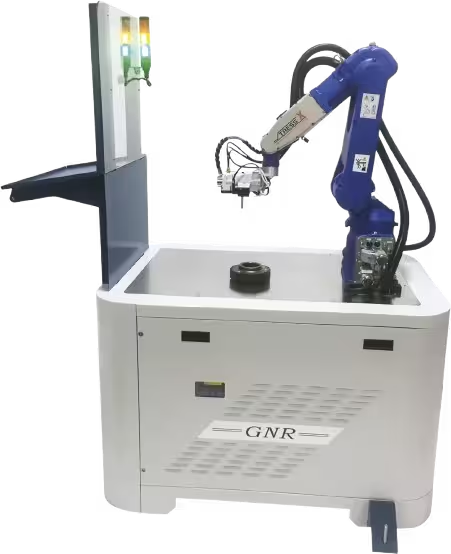
GNR StressX
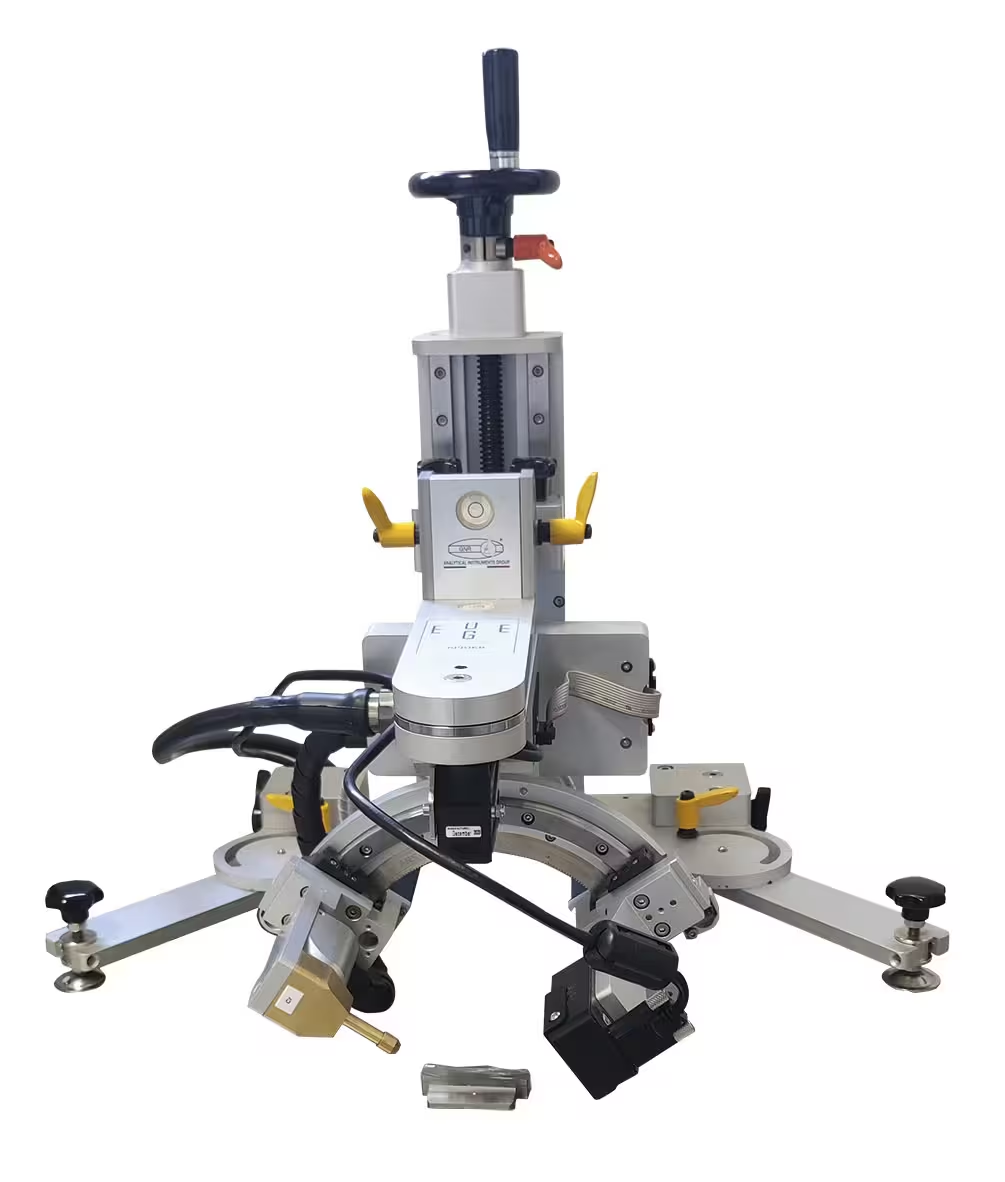
& SpiderX Edge

X-Ray Diffraction (XRD) Dectris Mythen2 R 1D ASTM E915 / UNI EN 15305 Residual Stress & Retained Austenite Stationary & Portable Options

GNR StressX and SpiderX Edge are industrial XRD diffractometer systems designed for residual stress and retained austenite measurement. StressX serves laboratory and production-line applications with a robotic arm; SpiderX Edge brings the same detector technology to the field in a 29 kg portable system.
<20 µm
Robot positioning accuracy
29 kg
SpiderX Edge total system weight
~2 h
SpiderX Edge battery autonomy
3 Standards
ASTM E915 / EN 15305 / E975-13
GNR StressX — 6-Axis Robotic XRD Residual Stress Analysis System
🤖
6-Axis
StressX anthropomorphic robot arm
🎯
<20 µm
StressX positioning and repeatability accuracy
📡
Mythen2 R 1D
Dectris single-photon counting detector (both systems)
300 W
StressX max. X-ray power (30 kV, 10 mA)
🧳
29 kg
SpiderX Edge total system weight
🔋
~2 h
SpiderX Edge battery autonomy (9 Ah, no charge)
ASTM / EN
E915, UNI EN 15305 and E975-13 compliant
🎯
<10 µm
SpiderX Edge laser alignment accuracy
GNR StressX — Robotic XRD Goniometer System

Robotic Reach for
Any Geometry

StressX integrates a compact XRD goniometer with a 6-axis anthropomorphic robot arm. Residual stress measurements on large and complex components are performed without additional fixturing or a zero-stress reference sample.
🤖
6-Axis Anthropomorphic Robot
Positioning and repeatability better than 20 µm. The robot arm handles all goniometer functions, enabling automated stress mapping on complex component geometries. Available working radii: 895 mm and 706 mm.
🔬
Psi Goniometer — Multiple Radii
Goniometer radius options: 120, 140, and 160 mm. 2Theta range 125°–164°. Suitable for Fe, Al, Ni, Cu, Ti, and Mg alloys. Standard anode: Cr; optional: Cu, Co, Fe, V, Ti, Mn.
💧
Integrated Closed-Loop Cooling
The water cooling system is self-contained; no external plumbing or water supply is required. An automatic shutdown activates if coolant flow drops. Power stability <25 ppm/h after a 2-hour warm-up.
GNR SpiderX Edge — Portable XRD Diffractometer

Field Measurement,
Laboratory Accuracy

SpiderX Edge is the smallest Theta/Theta diffractometer on the market. Battery operation, air cooling, and a 29 kg total weight make on-site measurement practical. No sample preparation required.

🔷
Theta/Theta Goniometer — 80 mm
The X-ray tube and detector move independently on motorized arms. 2Theta range 45°–170°; Psi scan from −45° to +45° with ±5° oscillation. Both vertical and horizontal positioning are supported.
🔋
Battery and Transport System
A 9 Ah battery provides approximately 2 hours of full operation without recharging; charging during operation is also supported. A waterproof, shock-resistant wheeled case houses all components for safe transport.
🎯
Laser Alignment — <10 µm
Contactless laser alignment prevents sample-instrument collision. Components with unconventional geometries can be measured without any sample preparation. Measurement range: 100 ±25 mm.

StressX or SpiderX Edge?

Both systems share the same detector technology and standards compliance. The application scenario and component size determine the right choice.

Specification GNR StressX GNR SpiderX Edge
Use CaseLaboratory / Production line (cabinet or wheeled)Portable / Field-first
Positioning System6-axis anthropomorphic robot (<20 µm accuracy)4-axis manual + motorized stage (Z, Φ, 2 tilts)
Goniometer GeometryPsi goniometer, r = 120 / 140 / 160 mmTheta/Theta, r = 80 mm
Psi Range−45° / +45°−45° / +45°
2Theta Range125° – 164°45° – 170°
Max. X-ray Power300 W (30 kV, 10 mA)4 W (40 kV, 0.1 mA)
Laser Accuracy2 µm (range: 150 ±40 mm)10 µm (range: 100 ±25 mm)
CoolingIntegrated water cooling (no external supply)Air-cooled (no water cooling required)
Battery9 Ah (~2 h full operation)
Total Weight250 kg (wheeled) / 350 kg (cabinet)29 kg (complete system)
DetectorDectris Mythen2 R 1DDectris Mythen2 R 1D
Standards ComplianceASTM E915, UNI EN 15305, ASTM E975-13ASTM E915, UNI EN 15305, ASTM E975-13

Which Industries
Use These Systems?

🚗
Automotive
Residual stress measurement on gears, springs, axles, and weld zones. XRD-based verification and optimization of shot peening parameters is now a routine production step.
✈️
Aerospace
Residual stress mapping on critical structural components for fatigue life estimation. The quantitative effect of compressive stress on corrosion resistance and fatigue performance is directly determined.
Energy
On-site measurement on turbine shafts, pipelines, and pressure vessel weld regions. Tensile residual stress is detected before it leads to premature failure.
🏭
Steel & Metallurgy
Monitoring the stress state introduced by rolling, casting, and heat treatment processes. Evidence-based data for refining process parameters and improving material performance.
🔩
Shot Peening QA
Comparative measurements before and after shot peening confirm that compressive residual stress has been increased by up to a factor of three. Standard protocol for process qualification.
🔬
Research & Development
Surface treatment optimization, new material characterization, and depth profiling via electrochemical polishing. Both stationary and portable instruments are suitable for laboratory R&D.
⚖️
Failure Analysis
Non-destructive identification of stress sources in damage investigations. In-situ measurement on a fracture surface or critical component provides direct evidence for determining the failure mechanism.
🏗
Quality Assurance
QA/QC process control in production lines. The homogeneity of grinding effects, induction hardening quality, and surface coating integrity are verified quantitatively by XRD.

Common Questions

If you need high-throughput measurement on large or heavy components in a laboratory or production-line setting, StressX is the better fit. If measurements are required on in-situ structures, large machinery, or across multiple locations, SpiderX Edge is the more practical choice. Both systems meet the same standards; the difference lies in component accessibility and positioning flexibility.

StressX uses a self-contained closed-loop water cooling circuit — no external plumbing or water connection is needed. SpiderX Edge is air-cooled and requires no water cooling at all. Both configurations simplify installation in facilities that lack dedicated coolant infrastructure.

Any polycrystalline material with sufficient crystallinity can be analyzed: ferritic and austenitic steels, aluminum, copper, titanium, magnesium, nickel alloys, and ceramics. Alongside the standard Cr anode, Cu, Co, Fe, V, Ti, and Mn anode options are available for different material systems.

Both systems comply with ASTM E915 and UNI EN 15305 for residual stress measurement, and with ASTM E975-13 for retained austenite determination. The software includes analysis modes that directly support these standards; measurement reports are generated in exportable formats.

Anka Analitik A.Ş. provides installation, commissioning, user training, scheduled maintenance, calibration, and spare parts supply throughout Türkiye. With over 25 years of experience in analytical instrumentation, our technical team is available to support your operation directly.

Request a Quote for
StressX / SpiderX Edge

Contact our team for technical consultation, a demonstration, or pricing information. Over 25 years of experience in analytical instrumentation.
📞
+90 (216) 577 52 96Call us
info@ankaanalitik.com.trSend an e-mail
💬
WhatsApp+90 549 252 76 46
📍
Kadıköy, Istanbul19 Mayıs Mah. Sumer Sok. Sumko Sitesi A7 Blok No:3CL
Quote / Information Request