XRF & ICP Sample Preparation
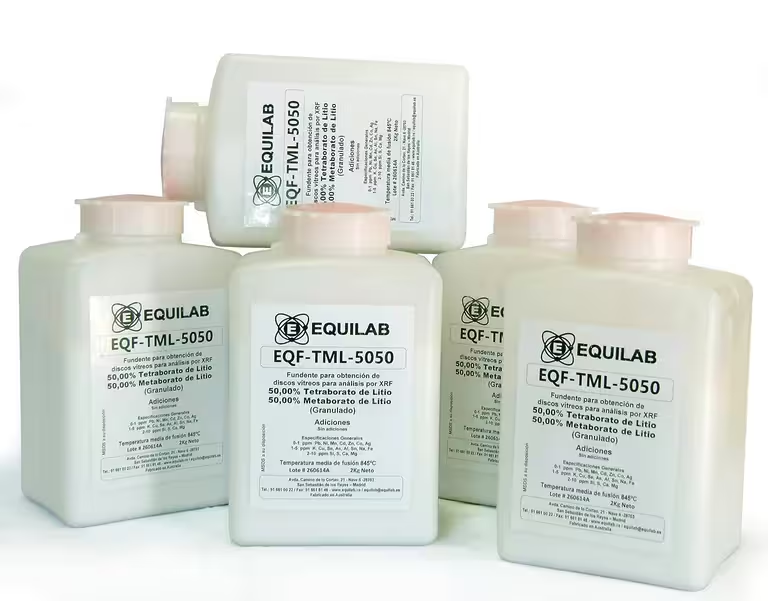
High-purity lithium borate fluxes for XRF glass disc and ICP solution preparation. 15 formulations — pure, bromide-added and iodide-added — covering a wide range of oxide matrices.
Alkaline Fusion Chemistry
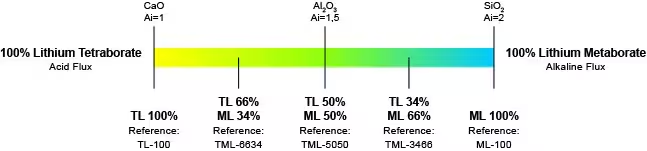
Lithium borate fluxes dissolve most oxide matrices at 950–1000°C into a homogeneous glass disc. The Tetraborate/Metaborate ratio balances alkalinity and fluidity for each sample type.
Product Range
From pure lithium borate fluxes to custom additive formulations — all compositions and application guidance in one place.
| Component | Formula | Properties | Preferred Application |
|---|---|---|---|
| Lithium Tetraborate | Li₂B₄O₇ | Melting point ~917°C · High alkalinity | Acidic silicate oxides, minerals |
| Lithium Metaborate | LiBO₂ | Melting point ~845°C · Maximum fluidity | Complex raw materials, ferroalloys |
| Lithium Bromide (release agent) | LiBr | 0.5% additive · Routine use | Easy glass disc release from platinum crucibles |
| Lithium Iodide (advanced release agent) | LiI | 0.5% additive · High performance | High-adhesion samples (Ni, Co, Ti ferroalloys) |
| Reference | Composition | Ideal For | Pack |
|---|---|---|---|
| TL-100 | TB 100% | Oxides, silicates, minerals | 2 kg granular |
| TML-6634 | TB 66% MB 34% | General purpose, versatile | 2 kg granular |
| TML-5050 | TB 50% MB 50% | Balanced alkalinity and fluidity | 2 kg granular |
| TML-3466 | TB 34% MB 66% | Ferroalloys, high-fluidity applications | 2 kg granular |
| ML-100 | MB 100% | Samples requiring maximum fusibility | 2 kg granular |
| Reference | Composition | Application | Advantage |
|---|---|---|---|
| TL-100-5 | TB 99.5% LiBr 0.5% | Silicate minerals | Reduces adhesion to Pt surface |
| TML-6634-5 | TB 66% MB 34% LiBr 0.5% | General use with release | Versatile + efficient |
| TML-5050-5 | TB 50% MB 50% LiBr 0.5% | Optimal balance | Best all-round ratio |
| TML-3466-5 | TB 34% MB 66% LiBr 0.5% | Ferroalloys, complex oxides | High throughput |
| ML-100-5 | MB 99.5% LiBr 0.5% | High-fluidity requirement | Easy release |
| Reference | Composition | Application | Advantage |
|---|---|---|---|
| TL-100-i5 | TB 99.5% LiI 0.5% | High-adhesion oxides | Guaranteed release |
| TML-6634-i5 | TB 66% MB 34% LiI 0.5% | Complex mixed samples | Superior versatility |
| TML-5050-i5 | TB 50% MB 50% LiI 0.5% | Universal application | Maximum performance |
| TML-3466-i5 | TB 34% MB 66% LiI 0.5% | Ferroalloys, refractory oxides | High throughput |
| ML-100-i5 | MB 99.5% LiI 0.5% | Fluidity + release combination | Premium performance |
Beyond the standard range, fluxes with custom release agents are available to order for non-standard analytical requirements.
Applications
From mining to cement, ferroalloys to research labs — alkaline fusion fluxes apply across a broad range of analytical matrices.
Frequently Asked Questions
Lithium Tetraborate (Li₂B₄O₇) melts at ~917°C and provides higher alkalinity, making it effective for dissolving acidic silicate oxides and minerals. Lithium Metaborate (LiBO₂) melts at ~845°C and is more fluid, preferred for complex matrices and ferroalloys. TML blends allow the user to set a specific balance between both properties.
Lithium Bromide (LiBr, 0.5%) is sufficient for routine samples — it ensures clean disc release at lower cost. Lithium Iodide (LiI, 0.5%) is reserved for high-adhesion samples such as Ni, Co and Ti ferroalloys where bromide may be inadequate. Note that LiI-containing fluxes absorb moisture more readily and should be stored in a sealed, dry environment.
The standard ratio is 5:1 to 8:1 (flux:sample). For refractory materials or complex oxides with high adhesion, a ratio of 8:1 to 10:1 may be required. The correct ratio directly affects disc quality, analytical accuracy and platinum crucible longevity.
Fluxes with release agents (LiBr or LiI) prevent glass discs from adhering to the crucible and reduce residue build-up. With regular cleaning, platinum crucibles can withstand hundreds of fusion cycles. Without a release agent, more frequent cleaning is required and crucible wear may increase.
Granular fluxes stored in sealed bottles at 15–25°C in a dry environment have a shelf life of 2–3 years. LiI-containing products absorb moisture faster; storage with a desiccant is recommended for long-term use. Once opened, bottles should be tightly resealed and kept away from moisture.
Yes. Trial samples of 50–100 g are available for pre-evaluation. Volume discounts apply for orders above 10 kg. If you require a custom formulation, our technical team can help determine the right flux for your specific matrix.
Quote & Information
Not sure which formulation suits your matrix? Our technical team will help you identify the right flux. Over 25 years of analytical instrumentation experience at your service.