Sample Preparation · XRF

Sample Preparation for XRF Analysis

XRF Sample
Preparation Instruments

Crushing Milling Pelletizing Fusion Equilab Series

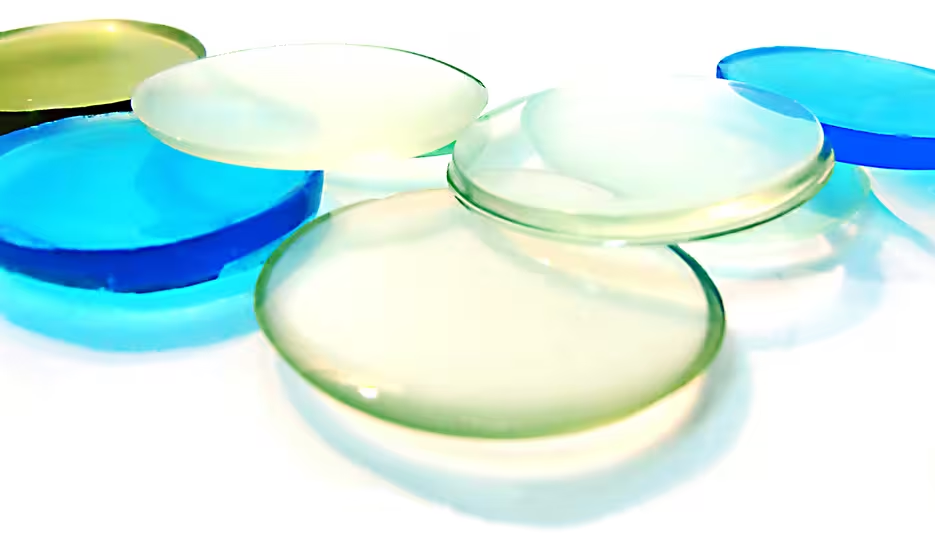
In XRF analysis, measurement accuracy depends heavily on sample homogeneity and surface quality. Raw material is first size-reduced and milled, then either compressed into a pellet or fused into a glass disc. A properly prepared sample lets your XRF spectrometer perform at its full capacity.
7
Instrument models
<45 µm
Target milling fineness
50 t
Max. press capacity
XRF Sample Preparation Instruments
🔨
EQJ Series
Jaw crusher — primary size reduction
⚙️
<45 µm
Target milling fineness (EQM-402 / EQR-200)
🗜️
30–50 t
Pellet press pressure range (EQP-30 / EQP-110 / EQP-210)
🔥
5–15 min
Induction fusion cycle time — FX Series

Three-Step Sample Preparation
for XRF

The XRF sample preparation workflow varies by sample type and required analytical precision. Crushing and milling ensure homogeneity; the final step is a choice between pelletizing or fusion.

Step 01
🔨
Size Reduction (Crushing)
Raw samples typically arrive at 5–50 mm. A jaw crusher (EQJ Series) reduces this to a fraction that the mill can accept. Manganese steel jaws handle hard rocks, slag, and mineral samples effectively.
Instrument used: EQJ-100 / EQJ-200
Step 02
⚙️
Fine Milling
XRF analysis typically requires the sample to be reduced below 45 µm. The ball mill (EQM-402) and ring mill (EQR-200) reach this fineness in 1–4 minutes. The ring mill is preferred for hard and abrasive samples.
Instrument used: EQM-402 · EQR-200
Step 03
🗜️
Pellet Pressing or Glass Disc Fusion
A pellet press (EQP-30 / EQP-110 / EQP-210) compacts the milled powder into a stable disc. When glass disc fusion is required, the FX Series induction fusion instrument dissolves the sample at 1050 °C using Li₂B₄O₇ flux to produce a homogeneous disc.
Instrument used: EQP-30 · EQP-110 · EQP-210 · FX Series

XRF Sample Preparation —
Equilab Series

A complete line from crushing and milling to pressing and fusion. Every instrument is designed by Equilab for laboratory environments.

Industries Using
XRF Sample Preparation

🏗️
Cement & Construction
Clinker, cement, gypsum and aggregate analysis. Incoming raw material and outgoing product quality control.
⛏️
Mining & Geochemistry
Major and minor element analysis in ore, rock and soil samples. Flotation and concentration monitoring.
🏭
Iron, Steel & Foundry
Rapid elemental analysis of slag, foundry sand and alloy samples. Production line quality control.
🏺
Ceramics & Glass
Raw material composition control, product homogeneity and process consistency. Clay and feldspar analysis.
🛢️
Petrochemicals
Catalyst, ash and residue analysis. Sulphur and heavy metal content monitoring. Process optimisation.
🌿
Fertilisers & Agriculture
Fertiliser composition analysis, soil nutrient determination and raw material verification procedures.
♻️
Environment & Waste
Heavy metal screening in waste, sediment and soil samples. Sample preparation compliant with EPA and ISO methods.
🔬
Research & Development
Sample standardisation for new material development, composition verification and reference material production.

XRF Sample Preparation

A glass disc is superior in terms of sample homogeneity and elimination of matrix effects. Especially in samples with high silica and alumina content, it achieves precision that pellet preparation cannot match. The pellet method is faster and less costly than fusion; it is preferred for routine quality control and samples with a well-known matrix. The appropriate method depends on sample type and the precision expected from the analysis.

The EQM-402 ball mill provides fast, fine grinding for samples ranging from soft to medium hardness. The EQR-200 ring mill is preferred for hard rocks, slag and mineral samples and also offers advantages in terms of contamination avoidance. Sample hardness (Mohs scale), desired final fineness and contamination tolerance determine model selection. Contact us for a demo or technical consultation.

The EQP-110 is suited for speed-focused routine use with its design that requires no safety door and its 7" touchscreen. The EQP-210 additionally supports FTIR KBr analysis alongside XRF and holds CE + UKCA certification; the wide 8–40 mm die range offers greater flexibility. Both models use a dual-cycle pressing system.

The FX Series most commonly works with lithium tetraborate (Li₂B₄O₇), lithium metaborate (LiBO₂), or mixtures of the two. Flux selection is made according to the oxide composition of the sample. Pre-calcination may be required for samples high in sulphur or carbon. Equilab technical documentation and application notes cover flux recommendations.

Let's Select the Right
Line for Your Sample

Speak with our expert team to select the right instrument for crushing, milling, pressing or fusion. If you have a sample, we can arrange a demo.

📞
+90 (216) 577 52 96Reach us by phone
info@ankaanalitik.com.trReach us by e-mail
💬
WhatsApp+90 549 252 76 46
📍
Kadıköy, Istanbul19 Mayıs Mah. Sumer Sok. Sumko Sitesi A7 Blok No:3CL
Information / Demo Request